
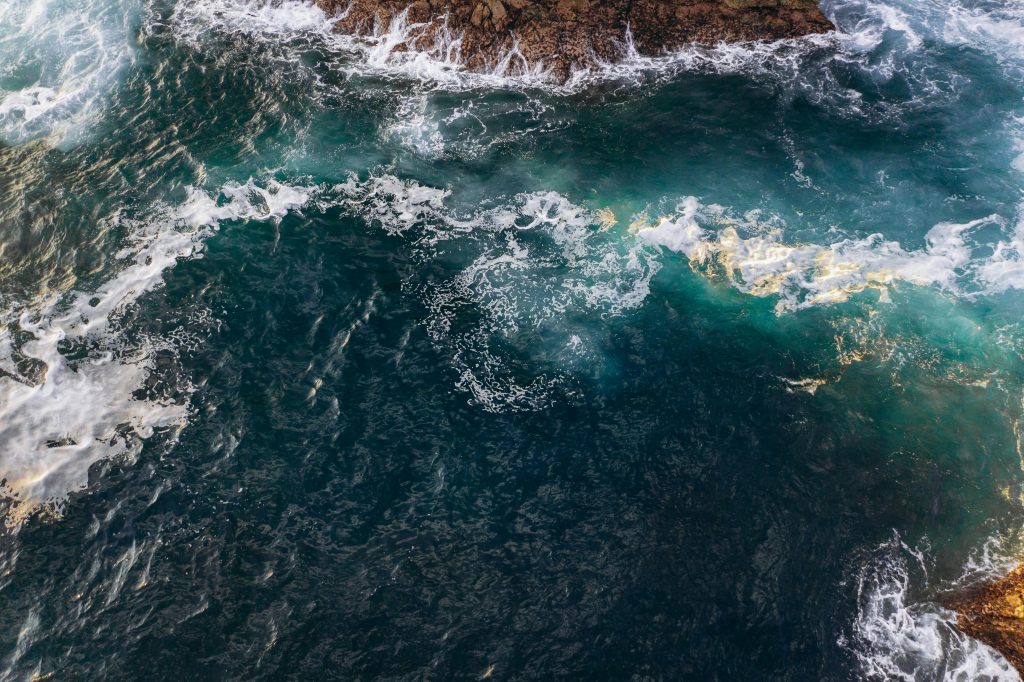
Marine energy captures energy from moving water or ocean gradients. It includes wave, tidal-stream, ocean-current and river-current technologies, along with less mature approaches that use thermal or salinity differences. The resource is large, but resource potential is not the same as electricity that can be economically or environmentally developed.
Main types of marine energy
- Wave energy: Devices extract energy from the motion of surface waves. Designs include point absorbers, oscillating water columns and other mechanical systems.
- Tidal-stream energy: Underwater turbines or other converters use predictable tidal currents rather than building a conventional tidal barrage.
- Ocean-current energy: Devices target persistent large-scale ocean circulation.
- River-current energy: Hydrokinetic devices can capture energy from flowing rivers without a traditional dam.
- Ocean thermal and salinity-gradient concepts: These use temperature or salinity differences and remain more application- and location-specific.
How large is the resource?
DOE estimates that the theoretical U.S. marine-energy resource is very large and could equal a substantial share of national electricity use. That figure should not be read as a deployment forecast. Technical, economic, environmental, permitting, transmission and site constraints determine how much can realistically be developed.
The most useful question is therefore not “Can the ocean power everything?” but “Which resource, device and location can deliver reliable energy at an acceptable cost and impact?”
Where the technology stands in 2026
Marine energy is still an emerging industry in the United States. DOE-supported developers continue to conduct laboratory, tank and open-water testing. DOE describes the sector as moving from basic performance demonstrations toward longer-duration validation, optimization and cost reduction, while European projects are further along in several technology categories.
Current federal work includes wave, tidal and river-current field tests, testing infrastructure, controls, power electronics and applications for remote communities and the “blue economy,” such as ocean observation or offshore operations.
Why marine energy is technically attractive
- Predictable resources: Tides are highly predictable, which can complement weather-dependent generation.
- High energy density: Water is far denser than air, so moving water can carry substantial energy through a compact area.
- Local energy options: Islands, remote coastal communities and offshore facilities may have use cases where local marine resources reduce dependence on imported fuel.
- Different generation profile: Waves and tides can produce at times that do not coincide with solar or wind output.
The hard engineering problems
Harsh operating conditions
Saltwater corrosion, biofouling, storms, cyclic loading and difficult maintenance conditions increase cost and reliability requirements. DOE specifically identifies access to realistic open-water testing as important because laboratory performance alone cannot establish long-term reliability.
Installation and maintenance
Offshore vessels, moorings, subsea cables, connectors and retrieval operations can dominate project logistics. Designs have to minimize maintenance while surviving extreme conditions.
Cost and scale
Many devices are still being demonstrated at relatively small scale. Reaching competitive energy costs requires reliable designs, repeatable manufacturing, improved controls and lower installation and operations costs.
Environmental and community impacts
Marine energy is renewable, but it is not impact-free. Projects can interact with marine mammals, fish, seabirds, sediment, navigation, fishing and other ocean uses. Site-specific monitoring and permitting are part of responsible deployment. Avoid claims that marine devices create “zero environmental impact” simply because they do not burn fuel while operating.
Grid power is not the only market
Some of the earliest practical applications may be smaller or isolated loads rather than utility-scale electricity. DOE research includes marine energy for remote communities, ocean sensors, aquaculture, desalination and other ocean-based industries where replacing batteries or transported fuel can have high value.
How to evaluate a marine-energy headline
- Distinguish theoretical resource potential from technically and economically recoverable energy.
- Check whether a project is a laboratory prototype, open-water demonstration or commercial array.
- Look for duration of field testing, capacity, reliability and maintenance data.
- Separate installed capacity from actual energy production.
- Check environmental monitoring and permitting rather than assuming “renewable” means impact-free.
Primary sources
- U.S. Department of Energy: Marine Energy Program
- DOE: Open-Water Marine Energy Tests
- DOE: Marine Energy Resource Assessment
Bottom line
Marine energy has a large physical resource and useful characteristics, especially for waves, tides and certain remote or ocean-based applications. In 2026, however, much of the U.S. sector remains in demonstration, validation and cost-reduction stages. The credible case for marine energy comes from measured field performance and site-specific economics—not sweeping claims about powering the world’s grid.