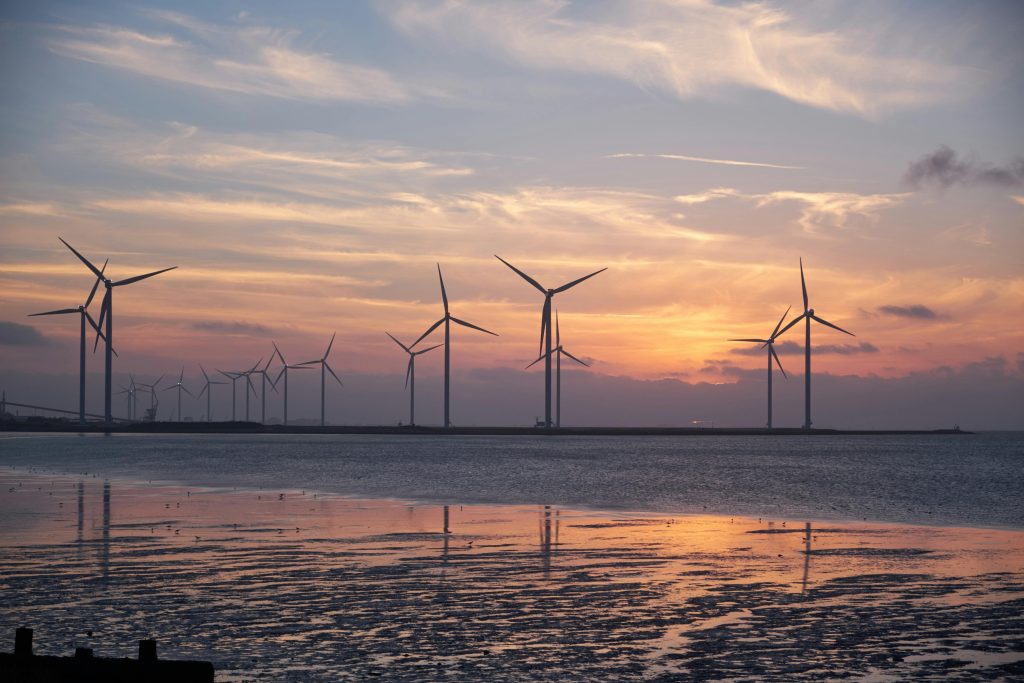
Wind energy converts the kinetic energy of moving air into electricity. Modern wind turbines use aerodynamic blades to turn a rotor; a drivetrain and generator then convert that mechanical rotation into electrical power. The technology ranges from small distributed turbines to large land-based and offshore projects.
How a wind turbine works
Wind flowing over a blade creates lift, causing the rotor to turn. The turbine’s control system adjusts operation based on wind speed and equipment conditions. Depending on the design, a gearbox may increase rotational speed before the generator, while some turbines use direct-drive generators.
Modern turbines also use sensors, power electronics and control software to manage loads, optimize production within safe limits and coordinate with the electric grid.
Land-based wind
Most installed U.S. wind capacity is land-based. Project performance depends heavily on the wind resource, turbine height, terrain, wake effects, grid access and siting constraints. Taller towers and larger rotors can access stronger winds and expand the number of sites that may be technically useful.
Offshore wind and floating systems
Offshore projects can access large wind resources and use very large turbines. Fixed-bottom foundations are common in shallower water. Floating platforms are being developed for deeper water where a foundation attached directly to the seabed becomes impractical or uneconomic.
Floating wind is not simply a larger land turbine placed on a raft. Platform motion, mooring systems, subsea cables, port infrastructure, installation vessels and severe offshore weather all affect engineering and cost.
What “smart” wind turbines actually means
Wind plants increasingly use condition monitoring, forecasting, digital controls and data analytics. These tools can support predictive maintenance, wake management and grid operation. It is more accurate to describe them as advanced sensing and control systems than to imply that artificial intelligence alone creates more wind or overrides physical turbine limits.
Key technical trends
- Larger rotors: More swept area allows a turbine to capture more energy from a given wind resource.
- Taller towers: Higher hub heights can access stronger or steadier winds at some sites.
- Advanced controls: Better sensing and plant-level control can reduce loads, improve reliability and coordinate turbines across a wind farm.
- Materials and recycling: Researchers are working on lighter structures, longer-lived components and more recyclable blade materials.
- Floating offshore systems: Continued R&D aims to reduce cost and make deep-water wind more practical.
Wind power is variable, not unreliable by definition
Wind output changes with weather. Grid planners manage that variability through forecasting, geographic diversity, transmission, flexible generation, demand response and storage where economic. A turbine’s capacity rating is the maximum output under specified conditions, not the energy it produces continuously.
Environmental and community considerations
Wind avoids fuel combustion during operation, but projects still have land, material, wildlife and community impacts. Responsible siting considers birds and bats, habitat, sound, visual effects, roads and transmission. Offshore development adds marine ecosystems, fisheries, navigation and coastal infrastructure.
DOE’s WINDExchange resources are designed to help communities evaluate both benefits and impacts rather than treating wind projects as impact-free.
Economics depend on the project
Wind can be a low-cost source of electricity at favorable sites, but there is no single cost that applies everywhere. Turbine price, financing, wind quality, construction, operations, transmission and interconnection all matter. Offshore projects generally face more complex construction and maintenance than land-based projects.
Distributed wind for homes, farms and businesses
Small or distributed wind can make sense where there is a strong measured wind resource, sufficient space, acceptable zoning and a suitable electrical interconnection. A rooftop-mounted micro-turbine in a turbulent urban location should not be assumed to perform like a utility-scale turbine on a tall tower.
How to evaluate a wind-energy claim
- Check whether a number refers to rated capacity or annual energy production.
- Ask what wind-speed assumptions and hub height were used.
- For new turbine concepts, distinguish prototypes from commercially deployed machines.
- Look for capacity factor, availability and operating history, not just maximum megawatts.
- Separate technical potential from projects that are economically and environmentally developable.
Primary sources
For related emerging technology research, see Solar Paint Technology and Solid-State Batteries.
Bottom line
Wind is a mature renewable electricity technology, while floating offshore platforms, advanced controls and new materials remain active areas of development. The useful way to evaluate wind is with site-specific resource data, measured output, project economics and environmental constraints—not broad claims that every new turbine innovation is a breakthrough.