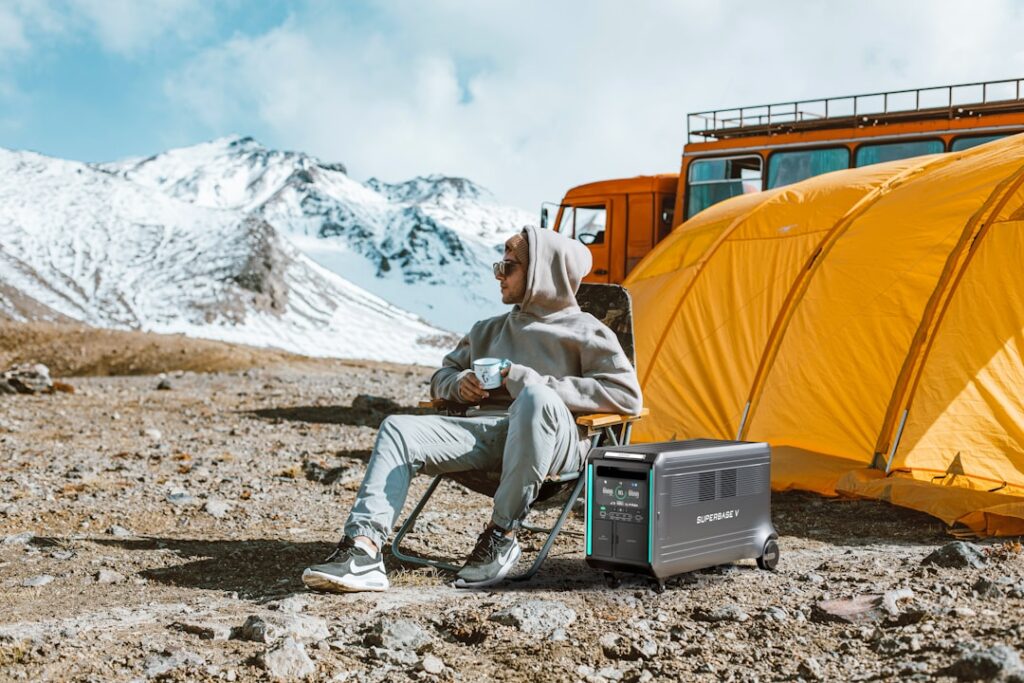
“Portable solar” usually means a folding or rigid panel paired with a power station or battery. The panel produces energy; the battery stores it; the inverter determines which AC devices the system can run. Buying by headline wattage alone is the most common mistake.
Start with daily energy, not panel size
List each device, its watts, and the hours you expect to use it. Multiply watts by hours to estimate watt-hours (Wh), then add roughly 20%–30% for conversion losses, temperature, imperfect sun, and reserve capacity.
| Use case | What to measure | Common constraint |
|---|---|---|
| Phones, lights and a laptop | Daily watt-hours and USB-C output | Charging speed and port mix |
| Camping refrigerator | Measured 24-hour consumption | Startup surge and hot-weather duty cycle |
| RV support | Battery capacity, solar input and alternator charging | Shade, roof area and connector compatibility |
| Home outage essentials | Continuous watts, surge watts and desired runtime | High-draw heaters, cooking appliances and air conditioning |
Use our RV Solar Sizing Calculator for a planning estimate, then compare its result with the battery and panel manufacturers’ limits.
Six specifications that matter
- Usable battery capacity: compare watt-hours, not just amp-hours, and check whether the stated capacity is nominal or usable.
- Continuous and surge output: both must fit the appliances you intend to run.
- Maximum solar input: a large panel array cannot help if the power station accepts less power.
- Voltage and connector range: confirm open-circuit voltage, current limits, connector type and polarity before combining equipment.
- Battery chemistry and warranty: compare cycle-life terms, temperature limits and warranty exclusions.
- Weight and charging options: portability may matter more than maximum capacity; AC and vehicle charging can be as important as solar.
How much solar panel capacity?
A simple planning estimate is daily watt-hours divided by effective peak-sun hours, then increased for system losses. A 1,000 Wh daily load divided by four effective sun hours is 250 W before losses; a practical starting point may be closer to 325 W. Shade, clouds, panel angle and heat can reduce real output substantially, so treat this as sizing—not a production guarantee.
Portable power is not whole-home backup
Small power stations are excellent for communications, lighting, refrigeration and electronics. They are usually poor matches for electric resistance heating, central air conditioning, electric water heating or long-duration whole-home use. For larger outage loads, compare an installed battery system using our Battery Backup Planner.
Before buying
- Measure or estimate the actual devices you need to run.
- Check continuous watts, surge watts and desired runtime.
- Confirm the battery’s solar-input voltage and current window.
- Price required panels, cables and adapters—not only the power station.
- Read the current manual, warranty and return policy.
One current product example
For a concrete reference point, you can view the current Anker SOLIX listing on Amazon. Treat it as an example, not a universal recommendation: verify its present capacity, output, solar-input limits, included components and warranty against your own load calculation.
Bottom line
The best portable system is the smallest one that safely meets your measured daily energy, surge and runtime needs—with enough charging headroom for imperfect conditions. Size the load first, then compare batteries and panels.